
Strengthening Groundwater Governance in Rapidly Urbanizing Areas of the Lower Mekong Region
This publication presents a project to strengthen groundwater governance in rapidly urbanizing areas of the Lower Mekong Region. It assesses groundwater availability and use, governance and policy frameworks, water access and security, and future pressures to support more equitable and sustainable groundwater management.
This article looks at the role of groundwater in the livelihoods and food security of millions of people, particularly in the developing world and its significance is growing.
Groundwater plays a significant role in the livelihoods and food security of millions of people, particularly in the developing world and its significance is growing. It is the main driver for the rural and regional economic growth of most of the countries as their agrarian economy is intricately linked with the groundwater irrigation.
Over the last couple of decades, the use of groundwater for irrigation has increased substantially all over the world. Globally, irrigated agriculture is the largest abstractor and predominant consumer of groundwater resources. It has brought major socioeconomic benefits to many rural communities in Asia, Middle East, North Africa, and Latin America – with numerous countries establishing large groundwater-dependent economies.
However, this extensive use of groundwater that contributed to the agricultural economy is under serious threats of resource depletion and degradation in many parts of Asia, particularly in South Asia. Long-term decline in groundwater levels, deterioration of groundwater quality, problems of salinity, drying up of wetlands, and low flows in streams and rivers during summer months – are all cited as undesirable environmental consequences of unplanned intensive groundwater use in agriculture.
In most situations, groundwater development progressed in stages without much coordination of activities towards aquifer management that resulted with time in a progressive decline in the water table and/or piezometric levels, associated with adverse environmental consequences as mentioned. It is imperative that efforts are made to understand the nature and behavior of the groundwater system and adopt adequate measures to regulate the abstraction of water so as to maintain certain groundwater levels and conserve its quality to meet the water use requirement as well as the requirement for groundwater-dependent ecosystem and to foster sustainable development and management of groundwater resources.
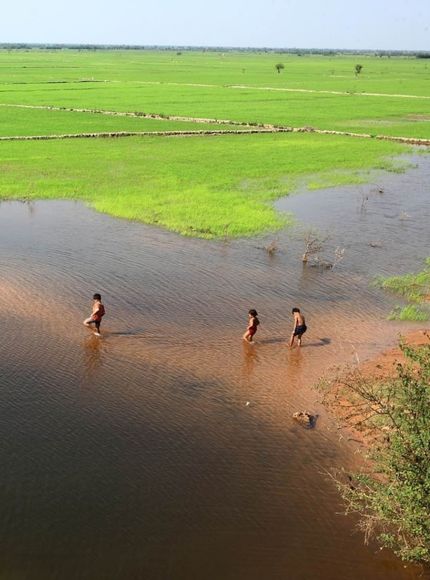
This article looks at the role of groundwater in the livelihoods and food security of millions of people, particularly in the developing world and its significance is growing.
Groundwater plays a significant role in the livelihoods and food security of millions of people, particularly in the developing world and its significance is growing. It is the main driver for the rural and regional economic growth of most of the countries as their agrarian economy is intricately linked with the groundwater irrigation.
Over the last couple of decades, the use of groundwater for irrigation has increased substantially all over the world. Globally, irrigated agriculture is the largest abstractor and predominant consumer of groundwater resources. It has brought major socioeconomic benefits to many rural communities in Asia, Middle East, North Africa, and Latin America – with numerous countries establishing large groundwater-dependent economies.
However, this extensive use of groundwater that contributed to the agricultural economy is under serious threats of resource depletion and degradation in many parts of Asia, particularly in South Asia. Long-term decline in groundwater levels, deterioration of groundwater quality, problems of salinity, drying up of wetlands, and low flows in streams and rivers during summer months – are all cited as undesirable environmental consequences of unplanned intensive groundwater use in agriculture.
In most situations, groundwater development progressed in stages without much coordination of activities towards aquifer management that resulted with time in a progressive decline in the water table and/or piezometric levels, associated with adverse environmental consequences as mentioned. It is imperative that efforts are made to understand the nature and behavior of the groundwater system and adopt adequate measures to regulate the abstraction of water so as to maintain certain groundwater levels and conserve its quality to meet the water use requirement as well as the requirement for groundwater-dependent ecosystem and to foster sustainable development and management of groundwater resources.

