Climate Risks, Regional Integration, and Sustainability in the Mekong Region
Rapid economic growth and climate risks are challenging livelihoods and ecosystems across the Mekong Region. This book brings together multi-country SUMERNET studies examining how climate change, regional integration, urbanization, and development affect sustainability, while highlighting the need for policies and actions tailored to vulnerable places and communities.
The Sustainable Mekong Research Network (SUMERNET) has produced a new book titled Climate Risks, Regional Integration, and Sustainability in the Mekong Region.
The book brings together multi-country empirical case studies, each of which included significant engagement with boundary partners, to analyze the impacts of, and ways to adapt to, climate risks and unsustainable growth in a highly interdependent region.
Rapid economic growth coupled with current and projected climate risks are challenging livihoods and ecosystems in the Mekong Region. In some locations unsustainable development has created or deepened vulnerabilities to climate change as well as global, regional, and transborder socioeconomic processes. More accessible and appropriate information is urgently needed on ways to reduce the negative aspects of development and adapt to the impacts of climate change in this region.
This book improves our understanding of the linkages between drivers, opportunities, and constraints on the sustainability of the Mekong Region’s ecosystems – at the transborder, sub-national, and local levels. Economic integration, urbanization, and climate change have impacts that vary greatly among locations. Hence, one key lesson in this book is that it is important to tailor policies and actions to specific places and communities, paying particular attention to the most vulnerable sections of the population, and the capacities of local actors. These multi-site and -country case studies provide much stronger tests of the merits and limitations of common policies than studies carried out in a single country, underlying the benefits of collaborative research.
Citation: Lebel, L., C.T. Hoanh, C. Krittasudthacheewa, R. Daniel (Eds.) (2014). “Climate risks, regional integration and sustainability in the Mekong region.” SIRD: Kuala Lumpur.
The book is available in the SUMERNET Secretariat at the SEI-Asia Centre in Bangkok and soon in key bookshops in the Mekong region. The book can also be ordered directly from the publisher SIRD in Malaysia.
Price: US$ 18. Please see attached flyer and order form for more details.
For more information please contact Agus Nugroho ([email protected]) or Rajesh Daniel ([email protected]).
SUMERNET Secretariat
15th Floor, Witthyakit Building, 254 Chulalongkorn University
Chulalongkorn Soi 64, Phyathai Road, Pathumwan
Bangkok, 10330, Thailand
Tel: +66 225 144 15 Email: [email protected]
Citation:
Lebel, L., Hoanh, C. T., Krittasudthacheewa, C., & Daniel, R. (Eds.). (2014). Climate Risks, Regional Integration, and Sustainability in the Mekong Region. Strategic Information and Research Development Centre and SUMERNET Secretariat, Stockholm Environment Institute (SEI) – Asia.
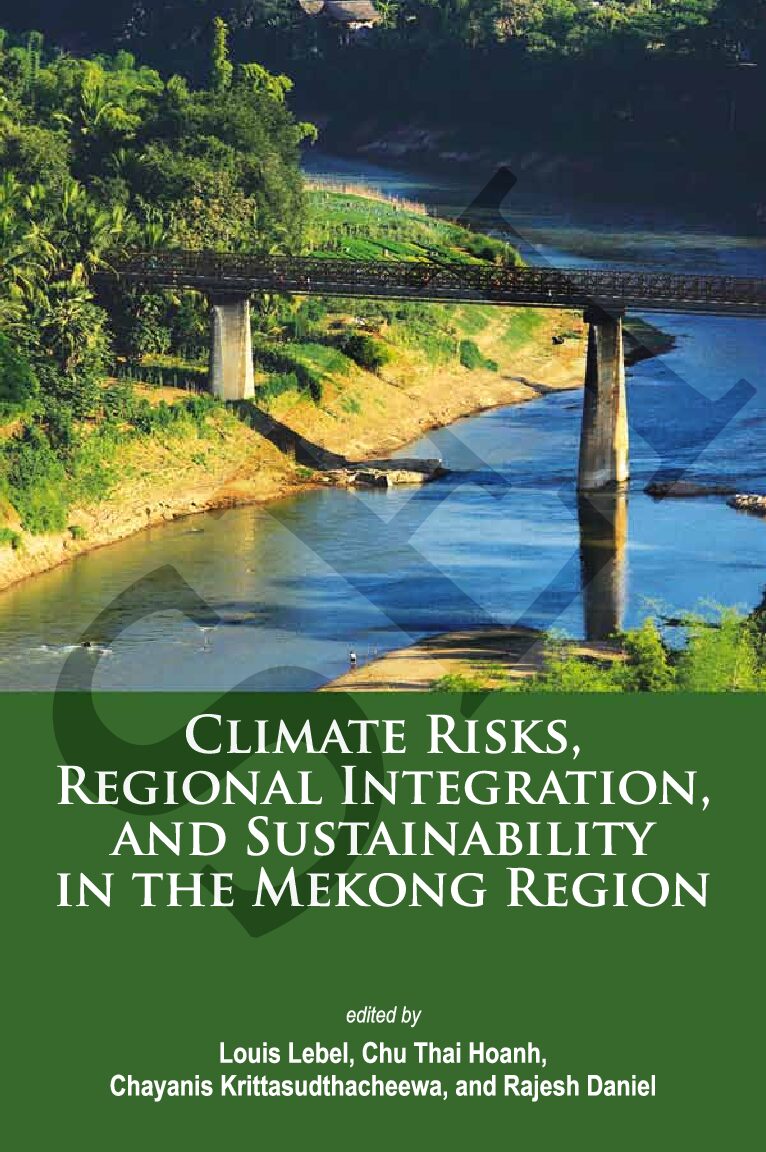
The Sustainable Mekong Research Network (SUMERNET) has produced a new book titled Climate Risks, Regional Integration, and Sustainability in the Mekong Region.
The book brings together multi-country empirical case studies, each of which included significant engagement with boundary partners, to analyze the impacts of, and ways to adapt to, climate risks and unsustainable growth in a highly interdependent region.
Rapid economic growth coupled with current and projected climate risks are challenging livihoods and ecosystems in the Mekong Region. In some locations unsustainable development has created or deepened vulnerabilities to climate change as well as global, regional, and transborder socioeconomic processes. More accessible and appropriate information is urgently needed on ways to reduce the negative aspects of development and adapt to the impacts of climate change in this region.
This book improves our understanding of the linkages between drivers, opportunities, and constraints on the sustainability of the Mekong Region’s ecosystems – at the transborder, sub-national, and local levels. Economic integration, urbanization, and climate change have impacts that vary greatly among locations. Hence, one key lesson in this book is that it is important to tailor policies and actions to specific places and communities, paying particular attention to the most vulnerable sections of the population, and the capacities of local actors. These multi-site and -country case studies provide much stronger tests of the merits and limitations of common policies than studies carried out in a single country, underlying the benefits of collaborative research.
Citation: Lebel, L., C.T. Hoanh, C. Krittasudthacheewa, R. Daniel (Eds.) (2014). “Climate risks, regional integration and sustainability in the Mekong region.” SIRD: Kuala Lumpur.
The book is available in the SUMERNET Secretariat at the SEI-Asia Centre in Bangkok and soon in key bookshops in the Mekong region. The book can also be ordered directly from the publisher SIRD in Malaysia.
Price: US$ 18. Please see attached flyer and order form for more details.
For more information please contact Agus Nugroho ([email protected]) or Rajesh Daniel ([email protected]).
SUMERNET Secretariat
15th Floor, Witthyakit Building, 254 Chulalongkorn University
Chulalongkorn Soi 64, Phyathai Road, Pathumwan
Bangkok, 10330, Thailand
Tel: +66 225 144 15 Email: [email protected]
Citation:
Lebel, L., Hoanh, C. T., Krittasudthacheewa, C., & Daniel, R. (Eds.). (2014). Climate Risks, Regional Integration, and Sustainability in the Mekong Region. Strategic Information and Research Development Centre and SUMERNET Secretariat, Stockholm Environment Institute (SEI) – Asia.