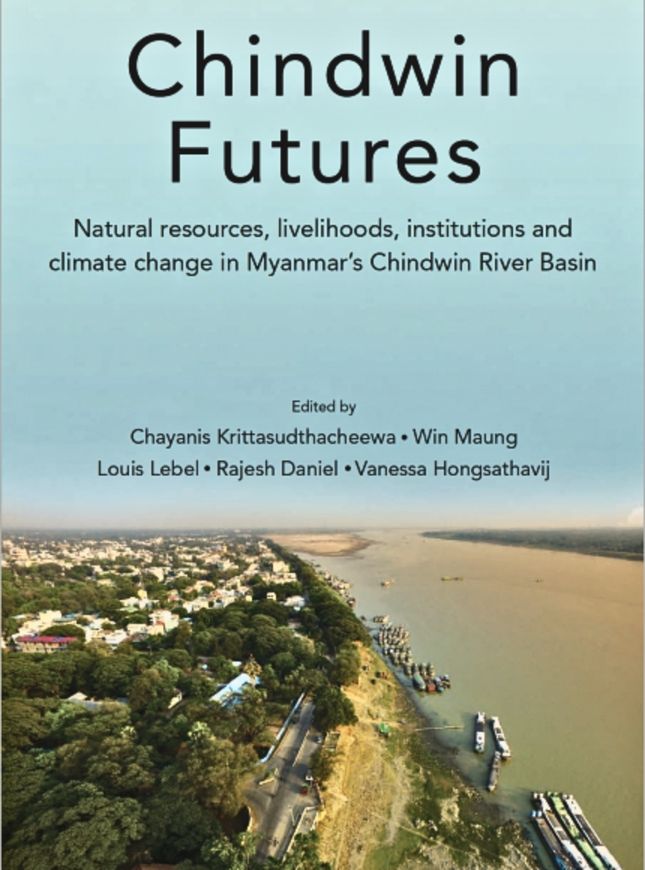
Chindwin Futures: Natural Resources, Livelihoods, Institutions and Climate Change in Myanmar’s Chindwin River Basin
This book provides a comprehensive socioecological assessment of Myanmar’s Chindwin River Basin, examining its natural resources, climate and flood risks, biodiversity, water use, livelihoods, socioeconomic development, and governance institutions. It brings together scientific assessments and stakeholder perspectives to support more sustainable and participatory river basin management.
Our work in Myanmar
During 2011 to 2020, Myanmar had been slowly opening up to the world once more. In this period, SEI and SUMERNET initiated work on environment issues in Myanmar primarily under three projects: Ayeyarwady Futures (2013-2014), Chindwin Futures (2015 – 2020) and Chindwin Biodiversity and Ecosystem Service (2017-2019).
Several experts from the organizations in Myanmar, including the Myanmar Environment Institute (MEI), cooperated closely with the international experts from the Stockholm Environment Institute (SEI) and other organizations worldwide to implement the various activities of the projects between 2013 and 2020.
This volume is a result of the work in “Chindwin Futures” Program that started in 2015 that focused on development of decision-support systems, water quality monitoring, capacity building and multi-stakeholder engagement.
What does this book provide?
This assessment of the Chindwin Basin shows that it is facing huge changes in land- and water-use that can both contribute to economic development but also cause environmental degradation and the further marginalization of vulnerable communities.
Identifying and understanding the interactions among multiple development and water-related activities in the Chindwin Basin, and the impacts of climate change, geography and economic transformation on biodiversity, water-use, and local livelihoods, is critical for integrated water resources planning and management.
The work in the Chindwin Basin was not restricted to research but also multi-stakeholder dialogues and building supportive institutions for water management. As a result of this assessment which took almost three years to complete, the Sagaing Regional Government established the Chindwin River Basin Organization (RBO), the first RBO in Myanmar, established with funding from the local government in partnership with a range of state and non-state actors, including local communities.
Who will find it useful?
This volume will prove of value to academics and researchers as well as media, donors and development partners working on natural resources and water governance issues in Myanmar, and in particular, the Chindwin River Basin, and especially for those studying river basin governance. The case studies herein will be useful for state agencies, development professionals, and environmental organizations in Myanmar and the Mekong Region, involved in natural resources management planning, policy-making and partnerships for environmental governance in Myanmar.
Our work in Myanmar
During 2011 to 2020, Myanmar had been slowly opening up to the world once more. In this period, SEI and SUMERNET initiated work on environment issues in Myanmar primarily under three projects: Ayeyarwady Futures (2013-2014), Chindwin Futures (2015 – 2020) and Chindwin Biodiversity and Ecosystem Service (2017-2019).
Several experts from the organizations in Myanmar, including the Myanmar Environment Institute (MEI), cooperated closely with the international experts from the Stockholm Environment Institute (SEI) and other organizations worldwide to implement the various activities of the projects between 2013 and 2020.
This volume is a result of the work in “Chindwin Futures” Program that started in 2015 that focused on development of decision-support systems, water quality monitoring, capacity building and multi-stakeholder engagement.
What does this book provide?
This assessment of the Chindwin Basin shows that it is facing huge changes in land- and water-use that can both contribute to economic development but also cause environmental degradation and the further marginalization of vulnerable communities.
Identifying and understanding the interactions among multiple development and water-related activities in the Chindwin Basin, and the impacts of climate change, geography and economic transformation on biodiversity, water-use, and local livelihoods, is critical for integrated water resources planning and management.
The work in the Chindwin Basin was not restricted to research but also multi-stakeholder dialogues and building supportive institutions for water management. As a result of this assessment which took almost three years to complete, the Sagaing Regional Government established the Chindwin River Basin Organization (RBO), the first RBO in Myanmar, established with funding from the local government in partnership with a range of state and non-state actors, including local communities.
Who will find it useful?
This volume will prove of value to academics and researchers as well as media, donors and development partners working on natural resources and water governance issues in Myanmar, and in particular, the Chindwin River Basin, and especially for those studying river basin governance. The case studies herein will be useful for state agencies, development professionals, and environmental organizations in Myanmar and the Mekong Region, involved in natural resources management planning, policy-making and partnerships for environmental governance in Myanmar.