
Mekong Delta, Vietnam’s Rice Bowl, Is Sinking
Climate change, saltwater intrusion and socio-economic shifts threaten rice farming and livelihoods in Vietnam’s Mekong Delta.
319_20241218_01
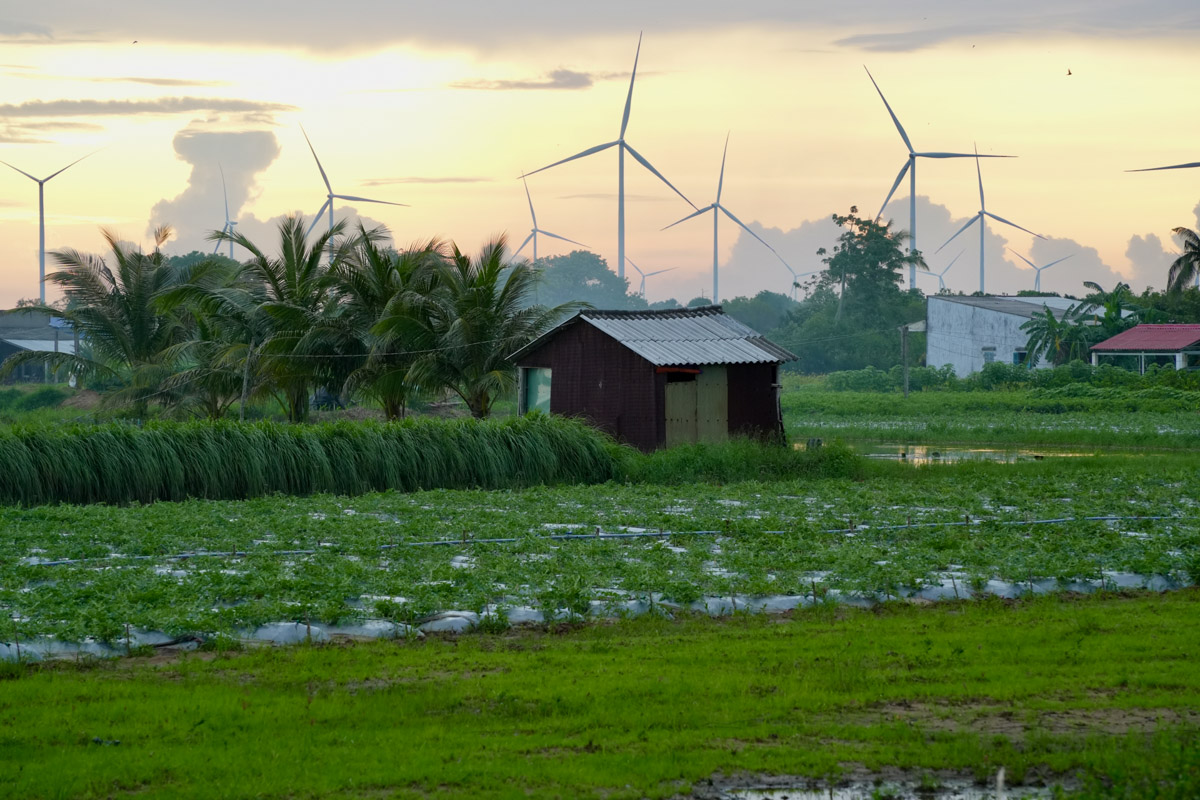
An agricultural landscape backdropped by markers of industrialisation in the Mekong delta. Photo: Rajesh Daniel.
The Mekong delta in Vietnam is a world in itself, where water and earth intertwine in a primeval dance, creating a region of incredible fecundity and profound beauty, a testament not only to nature’s bounty but also its relentlessness. Yet, beneath this surface of life and abundance, the Mekong delta is on the front lines of a deadly battle against climate change and environmental degradation.
A paper published in Sustainability 1 in 2020 pointed out that rising sea levels and erratic rainfall are causing more frequent and intense floods, even in urban areas. And a study in Agricultural Water Management2 in 2020 showed that salt-water intrusion had gone deep into the inland paddy fields as a consequence of rising sea levels, while prolonged droughts were turning fertile fields into barren wastelands.
Salinisation, in fact, threatens the very foundation of rice cultivation in the delta, thus jeopardising the livelihoods of millions. Modern industry, meanwhile, intrudes with machinery and concrete, cash crops and pesticides, factories and huge dams, which further disrupts the delta’s delicate ecological balance.
The delta’s future is further complicated by socio-economic changes. Urbanisation and industrialisation have increased the encroachments on agricultural land. Younger people are increasingly leaving rice cultivation and the delta for opportunities in the cities. The demographic shift is reducing the labour force available for rice farming, which is challenging the sustainability of traditional agricultural practices.
Continue reading on: Mekong delta, Vietnam’s rice bowl, is sinking | Frontline (frontline.thehindu.com)
Originally published in the Frontline, this article was authored by Rajesh Daniel at the Stockholm Environment Institute (SEI) Asia Centre, Thailand and My Lê, a fellow under the Mekong Thought Leadership and Think Tanks Program (MTT).
Notes and references
1. Hanh, P.T.T., &Furukawa, .T(2020). “Impact of climate change on flooding in Mekong delta: Case study of urban Can Tho”. Sustainability, 12(1), 1-17
2. Eslami, H,. Hoang, L. P,. Bregt, A. K,. Hoekstra, A. Y,. &van Vliet, M. T. (2020). “Climate change impacts on water availability and salinity intrusion in the Mekong delta: Implications for rice production. Agricultural Water Management, 241, 1063363 [Nguyen, H. N,. Le, T.V. H., &Vu, L. H. (2019). “Sustainable agricultural development in the Mekong delta: Challenges and solutions.” Sustainable Development and Agriculture, 3(2), 45-58; Also: https://www.statista.com/statistics/1196121/vietnam-mekong-delta-rice- production/

