
Alternative Upland Farming System Under Different Climate Scenarios
This study explores alternative upland farming systems under different climate scenarios, examining how agricultural practices can adapt to changing climate conditions and support more sustainable and resilient farming.
Climate change scenarios are useful in characterising future climate risks and for evaluating the performance of adaptation options, but most scenarios operate at the national or greater scale. These projected climate scenarios have to be downscaled to determine more precisely the appropriate local response actions. Such downscaled projections can be used by planners in designing innovative CA technologies for the Philippine uplands and in planning R&D to improve the current upland farming practices and climate change adaptation in the country.
We present projected climate change scenarios in selected Philippine uplands in 2020, 2050 and 2080; their potential impacts on rice yield if current practices continue; and recommended alternatives to achieve food security and sustainability. The results can be used by local planners in preparing local plans to mitigate social, economic and environmental impacts of climate variability and extremes on a specific sector.
In a SUMERNET- and CDKN-funded project on climate change, food security and livelihoods of small-scale farmers, we collected data on rice yields and production practices in the Philippine provinces of Tarlac and Pangasinan through key informant interviews, focus group discussions and interviews with rice farmers.
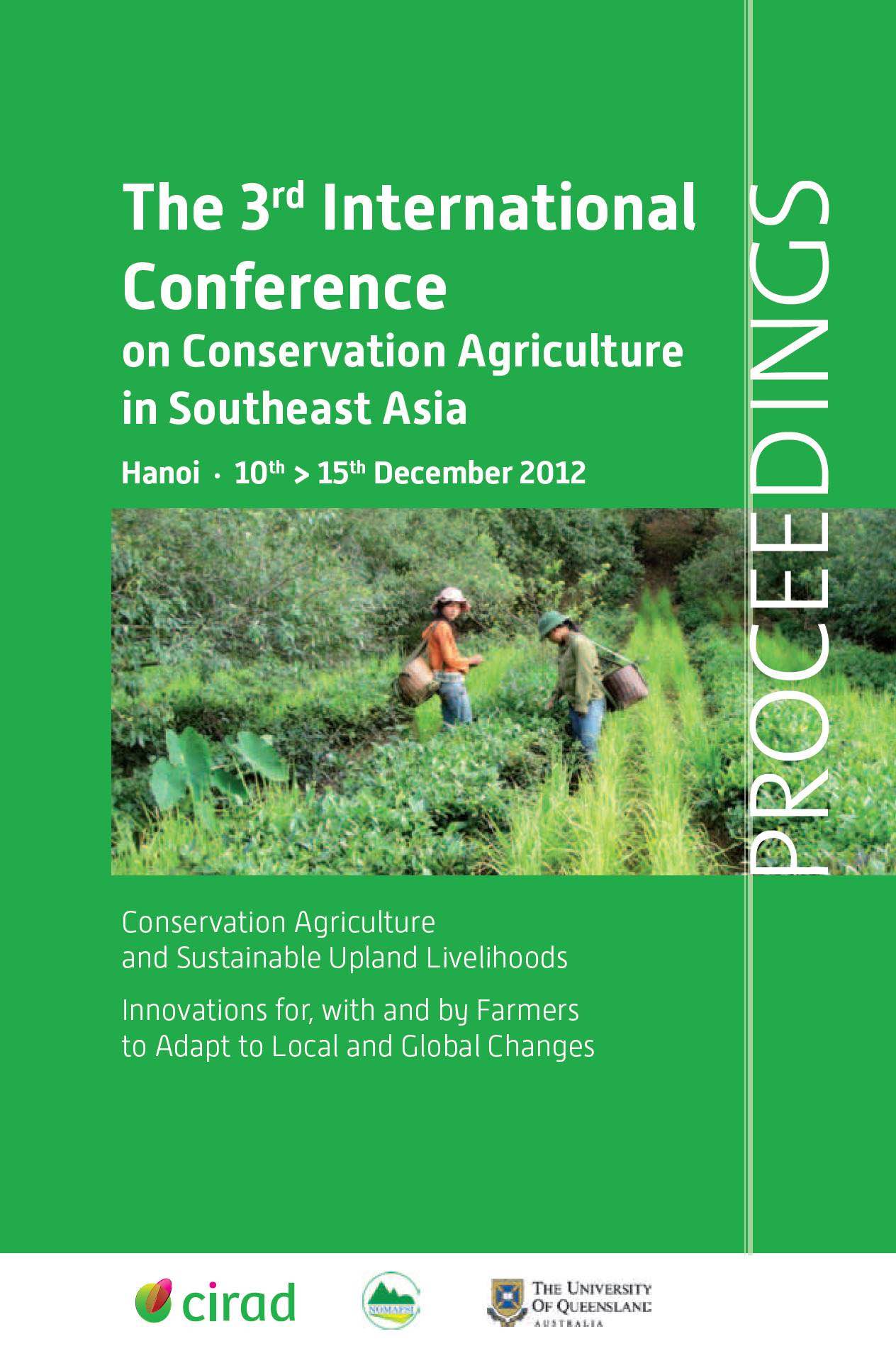
Note: This article was published in Proceedings: The 3rd International Conference on Conservation Agriculture in Southeast Asia.
Climate change scenarios are useful in characterising future climate risks and for evaluating the performance of adaptation options, but most scenarios operate at the national or greater scale. These projected climate scenarios have to be downscaled to determine more precisely the appropriate local response actions. Such downscaled projections can be used by planners in designing innovative CA technologies for the Philippine uplands and in planning R&D to improve the current upland farming practices and climate change adaptation in the country.
We present projected climate change scenarios in selected Philippine uplands in 2020, 2050 and 2080; their potential impacts on rice yield if current practices continue; and recommended alternatives to achieve food security and sustainability. The results can be used by local planners in preparing local plans to mitigate social, economic and environmental impacts of climate variability and extremes on a specific sector.
In a SUMERNET- and CDKN-funded project on climate change, food security and livelihoods of small-scale farmers, we collected data on rice yields and production practices in the Philippine provinces of Tarlac and Pangasinan through key informant interviews, focus group discussions and interviews with rice farmers.
Note: This article was published in Proceedings: The 3rd International Conference on Conservation Agriculture in Southeast Asia.

