
Rubber in the GMS: An Integrated Research Exercise on Rubber Development in Lao PDR
This research synthesizes findings from integrated studies on rubber development in Lao PDR, examining its economic, social, and environmental impacts. It highlights changes in land use, livelihoods, natural resource management, and policy, offering recommendations to promote more sustainable and inclusive rubber development in the Greater Mekong Subregion.
Rubber is one of the hottest commodities in world markets. Many Asian countries are the major rubber producers. Lao PDR is also influenced by surrounding by important rubber producers and markets such as Thailand, China, and Vietnam. While rubber cultivation is expanding rapidly in Lao PDR, the Government and different international organisations, including institutional arrangements, planning, policy, regulation and the information that supports, are paying great attention and express their concerns on the industry. Many issues related to rubber were raised and discussed within related agencies. The Vientiane Smallholder Rubber Workshop in June 2006 and the NAFRI Rubber Stakeholders Meeting in December 2006 also had highlighted many concerns about the economic, social and environmental impacts of the rapidly expanding sector including the rapid, unplanned and uncontrolled landscape change and lack of information, transparency, and
accountability in the rubber plantation.
The objectives of this research were to 1) explore the existing policy support for farmers planting rubber, contract system between investor and producer, credit support for farmers, facilitation in terms of permission for rubber plantation and trade, different regulations including taxes and make a market analysis, 2) make an analysis of the market options for farmers planting rubber and examine factors having an impact on market efficiency and analyze the market chain, 3) make a livelihood analysis, change of standard of living, agricultural practices and relationship between farmers since the inception of rubber planting, and 4) determine the regional aspects of rubber plantation and option and finally come up with the policy briefs for suitable land use, technical aspects, socio-economic and livelihood improvement. The research methodology used was intergraded with different techniques such as reviewing secondary information, conducting in-depth face-to-face interviews by using both interview guidelines and structural interview question with rubber farmers and other government stakeholders. After that the data was analysed by using SPSS for Microsoft Windows to find out the statistics such as frequencies, percentage, mean, maximum, and minimum.
The results were found that there are some existing supports to the farmers planting rubber such as financial support from the Agricultural Promotion. The government initiated some policies to eliminate slash and burn agriculture and establish a permanent crop. The government also initiated the policy for poverty eradication by the year 2020, which farmers have to increase their income. Planting rubber trees is one of the promoted agricultural activities. The price and marketing for rubber product is different according to product quality and form. In the northern provinces, the rubber is marketed to China through the middleman. On the other hand, the rubber product marketing in the central part is quite a high price and sold to Thailand.
The rubber farmers in the northern part had low education, which are only up to primary school levels. In addition they have a very limited land area holding. However, they have higher household labour than other parts, while the rubber farmers in the central and southern parts have limited household labour comparing to the rubber production areas. The rubber farmers in the northern part had very limited off-farm income. The farmers in all parts raised animals such as poultry, cattle, goats, and pigs for their home consumption mainly. It has been found that rubber plantation had some impacts on small holder farmers in terms of agricultural land and productions. However, it provides some positive support to the government strategy in stop shifting cultivation.
In order to improve the existing rubber production and reducing the impacts of both individual farmer and farmer organisation, it is recommended as follow:
Northern Province
- Provide technical support on rubber production techniques, pest and disease control, post harvest to improve the quality, and other agricultural production techniques which can integrate with rubber plantation to generate more income or secure the food during the start of planting;
- Strengthen the rubber production group by providing capacity building skills for the group member in planning and management, accounting, and marketing and increase the role of the production group in marketing process to reduce the middleman and increase the profit;
- Prepare the crop calendar and planning for harvesting and marketing among the group members to reduce the over supply;
- Set up post-harvest facilities such as a dry and storage facility for value added to the rubber product and grade the product and apply a primary processing to increase the value of the product before export;
- Review the contract between farmers and the farmer organisation and the farmer organisation and the private trade company;
- Consider to provide more rubber production areas for the farmers if it is possible; If it is not possible provide support on off-farm income generation for the rubber farmers, because they still have sufficient labour;
Central and Southern Provinces
- Establish rubber organisation or production group with providing capacity building skills for the group member in planning and management, accounting, and marketing;
- Provide technical support on rubber production techniques and other agricultural production techniques which can integrate with rubber plantation to generate more income or secure the food during the start of planting;
- Set up post-harvest facilities such as a dry and storage facility for value added to the rubber product and grade the product and apply a primary processing to increase the value of the product before export;
- Review the contract between farmers and the farmer and the private investment company; and
- Consider the process to hire labour for harvesting the rubber, because the rubber farmers in the central and southern parts have limited household labour.
Policy Recommendation for the Government of Lao PDR
Based on the result of the study, small holders still need a lot of supports in terms of to enhance production capacity, quantity and quality, and marketing. Therefore, the government should consider some policies to support them as follows:
- Setting up an organisation or centre to be responsible for rubber research and development. This centre can be all rubber information centre;
- Increase capacity for technical staff in rubber production, marketing, research and development;
- Ministry of Agriculture and Forestry should provide technical experts to support small holder rubber farmers;
- Identifying suitable land areas for increasing the production with minimizing environmental impact;
- Increasing value added to rubber products by processing in the country before export;
- Revising existing policies such as 2+3 policy, 1+4 policy, and land concession policy, because it may be adapted in one area, but not in others ;
- Allocating sufficient land to individual farmers;
- Land use planning for different economical agricultural production;
- Integrated farming in rubber plantation area;
- Developing models for rubber groups and expending into different part of the country; and
- Increase the rubber processing facilities in different part to increase value added for the product.
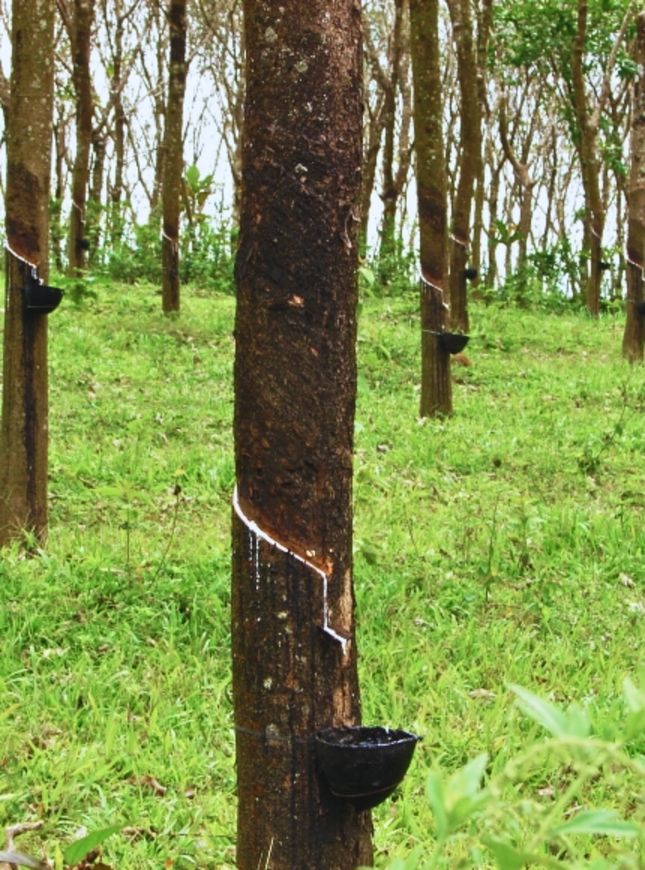
Rubber is one of the hottest commodities in world markets. Many Asian countries are the major rubber producers. Lao PDR is also influenced by surrounding by important rubber producers and markets such as Thailand, China, and Vietnam. While rubber cultivation is expanding rapidly in Lao PDR, the Government and different international organisations, including institutional arrangements, planning, policy, regulation and the information that supports, are paying great attention and express their concerns on the industry. Many issues related to rubber were raised and discussed within related agencies. The Vientiane Smallholder Rubber Workshop in June 2006 and the NAFRI Rubber Stakeholders Meeting in December 2006 also had highlighted many concerns about the economic, social and environmental impacts of the rapidly expanding sector including the rapid, unplanned and uncontrolled landscape change and lack of information, transparency, and
accountability in the rubber plantation.
The objectives of this research were to 1) explore the existing policy support for farmers planting rubber, contract system between investor and producer, credit support for farmers, facilitation in terms of permission for rubber plantation and trade, different regulations including taxes and make a market analysis, 2) make an analysis of the market options for farmers planting rubber and examine factors having an impact on market efficiency and analyze the market chain, 3) make a livelihood analysis, change of standard of living, agricultural practices and relationship between farmers since the inception of rubber planting, and 4) determine the regional aspects of rubber plantation and option and finally come up with the policy briefs for suitable land use, technical aspects, socio-economic and livelihood improvement. The research methodology used was intergraded with different techniques such as reviewing secondary information, conducting in-depth face-to-face interviews by using both interview guidelines and structural interview question with rubber farmers and other government stakeholders. After that the data was analysed by using SPSS for Microsoft Windows to find out the statistics such as frequencies, percentage, mean, maximum, and minimum.
The results were found that there are some existing supports to the farmers planting rubber such as financial support from the Agricultural Promotion. The government initiated some policies to eliminate slash and burn agriculture and establish a permanent crop. The government also initiated the policy for poverty eradication by the year 2020, which farmers have to increase their income. Planting rubber trees is one of the promoted agricultural activities. The price and marketing for rubber product is different according to product quality and form. In the northern provinces, the rubber is marketed to China through the middleman. On the other hand, the rubber product marketing in the central part is quite a high price and sold to Thailand.
The rubber farmers in the northern part had low education, which are only up to primary school levels. In addition they have a very limited land area holding. However, they have higher household labour than other parts, while the rubber farmers in the central and southern parts have limited household labour comparing to the rubber production areas. The rubber farmers in the northern part had very limited off-farm income. The farmers in all parts raised animals such as poultry, cattle, goats, and pigs for their home consumption mainly. It has been found that rubber plantation had some impacts on small holder farmers in terms of agricultural land and productions. However, it provides some positive support to the government strategy in stop shifting cultivation.
In order to improve the existing rubber production and reducing the impacts of both individual farmer and farmer organisation, it is recommended as follow:
Northern Province
- Provide technical support on rubber production techniques, pest and disease control, post harvest to improve the quality, and other agricultural production techniques which can integrate with rubber plantation to generate more income or secure the food during the start of planting;
- Strengthen the rubber production group by providing capacity building skills for the group member in planning and management, accounting, and marketing and increase the role of the production group in marketing process to reduce the middleman and increase the profit;
- Prepare the crop calendar and planning for harvesting and marketing among the group members to reduce the over supply;
- Set up post-harvest facilities such as a dry and storage facility for value added to the rubber product and grade the product and apply a primary processing to increase the value of the product before export;
- Review the contract between farmers and the farmer organisation and the farmer organisation and the private trade company;
- Consider to provide more rubber production areas for the farmers if it is possible; If it is not possible provide support on off-farm income generation for the rubber farmers, because they still have sufficient labour;
Central and Southern Provinces
- Establish rubber organisation or production group with providing capacity building skills for the group member in planning and management, accounting, and marketing;
- Provide technical support on rubber production techniques and other agricultural production techniques which can integrate with rubber plantation to generate more income or secure the food during the start of planting;
- Set up post-harvest facilities such as a dry and storage facility for value added to the rubber product and grade the product and apply a primary processing to increase the value of the product before export;
- Review the contract between farmers and the farmer and the private investment company; and
- Consider the process to hire labour for harvesting the rubber, because the rubber farmers in the central and southern parts have limited household labour.
Policy Recommendation for the Government of Lao PDR
Based on the result of the study, small holders still need a lot of supports in terms of to enhance production capacity, quantity and quality, and marketing. Therefore, the government should consider some policies to support them as follows:
- Setting up an organisation or centre to be responsible for rubber research and development. This centre can be all rubber information centre;
- Increase capacity for technical staff in rubber production, marketing, research and development;
- Ministry of Agriculture and Forestry should provide technical experts to support small holder rubber farmers;
- Identifying suitable land areas for increasing the production with minimizing environmental impact;
- Increasing value added to rubber products by processing in the country before export;
- Revising existing policies such as 2+3 policy, 1+4 policy, and land concession policy, because it may be adapted in one area, but not in others ;
- Allocating sufficient land to individual farmers;
- Land use planning for different economical agricultural production;
- Integrated farming in rubber plantation area;
- Developing models for rubber groups and expending into different part of the country; and
- Increase the rubber processing facilities in different part to increase value added for the product.

