Gendered Impact of Cross-Border Agricultural Investment: Case of Rubber Plantations in Northern Laos, Myanmar, and Cambodia (GIAI-Rubber)
This project examines the gendered impacts of cross-border investments in rubber plantations in Lao PDR, Myanmar and Cambodia, focusing on land access, rural livelihoods and inequalities affecting women and men in local communities.
Gendered impact of cross-border agricultural investment
The Mekong Region has seen a large number of cross-border investment projects in agriculture. Investors in Lao PDR and Myanmar come from China, while Cambodia receives investment from Vietnam. Considerable research has examined the impacts of contract farming with Chinese companies and investment in rubber plantations. However, most studies have used the household as the basic unit of analysis and have not differentiated impacts on women and men.
Anecdotal evidence suggests that women bear socio-economic costs during the transition to rubber production. Gender analysis can help develop a holistic understanding of livelihood changes following the development of rubber plantations. This research compares Laos, Myanmar, and Cambodia.
Research Questions
The overall research question is: What are the gendered impacts of cross-border rubber investment in Laos, Cambodia, and Myanmar, and how can inclusive investment policies be shaped?
To answer this question, the study conducts a gender analysis focused on three dimensions: changes in people’s livelihoods, rubber plantation benefit-sharing mechanisms, and cross-border investment policy. Specifically, it asks:
- How and why has women’s and men’s access to farmland and forest products changed with the expansion of rubber plantations by foreign companies?
- How and why do different rubber plantation benefit-sharing models shape women’s and men’s benefits and their bargaining power in relation to companies?
- How do the economic and trade policies of Laos, Myanmar, and Cambodia with respect to neighbouring countries shape the arrangements and management of rubber plantations?
Objectives
To contribute to evidence-based, inclusive investment and trade policy development, the research project conducts a gender analysis of cross-border rubber investment in Laos, Cambodia, and Myanmar. With a focus on northern Laos, it also studies northeastern Cambodia and northern Myanmar to compare approaches and arrangements under different socio-political frameworks.
The overall development goal is to explore cross-border agricultural investment policies that protect the rights of small farmers, especially marginalized women farmers.
Specific Objectives
- Analyse the impacts of rubber plantations on small farmers’ livelihood options, gender roles, and intra-household gender relations.
- Compare how different investment and payment schemes, ethnicity, and location affect livelihoods and gender relations.
- Explore how and why these differences occur, and how investment and trade policies shape terms of trade and gendered power relations at the grassroots level.
- Investigate how women’s and men’s strategies and agency shape the implementation of investments and company payments.
- Strengthen existing policy recommendations on rubber plantation expansion to support more specific and gender-sensitive investment policies.
Methodology
The study focuses on the gendered effects of rubber investment and uses two types of data:
- Qualitative data: Semi-structured interviews, focus group discussions, and in-depth interviews will help the team understand how different factors influence the outcomes of rubber plantation investments.
- Quantitative data: Household surveys will assess the extent of changes in income-generating activities, gender division of labour, and income.
Expected Policy Impacts
The countries included in the study have policies promoting intensive investment in agricultural land through various plans and laws. The project will refer to the principles of responsible agricultural investment that respects rights, livelihoods, and resources, as well as the FAO’s Voluntary Guidelines on the Responsible Governance of Tenure of Land, Fisheries and Forests in the Context of National Food Security.
NGOs and academics have already made recommendations on these issues. Rather than starting from scratch, the project will build on existing recommendations and identify barriers to their implementation. These recommendations include providing technical and financial support to small farmers, strengthening producer groups and government oversight, and promoting corporate social responsibility (CSR) among investing companies.
The study will contribute additional context and concrete actions to strengthen smallholders’ negotiating power while making the different needs and negotiating power of women and men more visible.
Timeframe
28 April 2015 – 28 April 2015
Kyoko Kusakabe
Gender and Development Studies, School of Environment, Resources and Development, Asian Institute of Technology
P.O.Box, Klong Luang, Pathumthani 12120, Thailand
Email: [email protected]
Related Stories
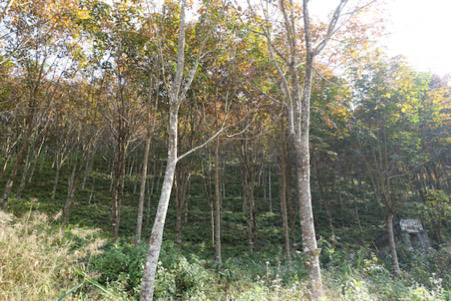
As private rubber plantations expand under the supervision of armed groups in northeastern Myanmar, village people lose their lands and are forced to migrate elsewhere to work. One woman narrates her story of how the private sector’s expansion of rubber p